
The Smart Mouth Book Club

When I was first invited to join my book club, I hesitated in saying yes. I adore the friend who invited me—she’s a librarian and has impeccable taste in books. We had several mutual friends who were also members, so I knew I’d have a good time, but I was thinking about my long to-be-read list, which includes a tower of books precariously balanced on my nightstand and quite a few novels on my bookshelf. Did I really want to commit to reading a prescribed book each month when I had so many other books I wanted to read? What if I didn’t like the selections?
In spite of my initial misgivings, I’m glad I joined. We’re a casual, low-pressure group. Nobody gets flogged if they don’t finish the book. We’re also democratic—we take turns picking books and hosting. And, we love food. Everyone brings a dish when we meet. Sometimes, if a book is food-oriented, someone will make an entrée or desert inspired by what we read. There’s no pressure over food though, which is nice. Some of us love to cook. Others (like me) prefer eating over cooking, so hanging out with talented cooks is a definite perk. Sure, sometimes I like to bake, but my good friend Costco makes a great apple pie, so why go to the trouble?
Besides sampling new recipes, we’ve gotten to read books we wouldn’t have chosen ourselves, or that we’ve always wanted to read but haven’t. We’ve been diverse as far as genre: historical fiction, humor, mystery, romance, memoir, fantasy, science fiction, and most recently, non-fiction. We just finished reading Wealth Woman, by Deb Vanasse, which is about a Native woman who was a prominent figure in the Klondike gold rush. I loved the book because it offered an alternative historical perspective. Since the author is local, we invited her to join us for our meeting. It was great to hear more about the book and her writing process.
 This is the second time we’ve had an author join us. The first time we hosted an author, we met with Holly Lorincz, author of Smart Mouth. This award-winning book is about a young woman’s first year as a teacher and debate coach at a small coastal high school. We had such a great time with Holly, we decided to name our group after the book. It seemed fitting, given that we all have an appreciation for humor and speak sarcasm fluently.
The socialization has been beneficial too. As a writer and an introvert, I spend a lot of time in my own head. Sometimes I get so immersed in writing, I forget to open the shades—I’m pretty sure my neighbors think I’m a vampire. Getting out of the house is a good thing for me, especially among people who love books as much as I do.
© Melissa Eskue Ousley 2016
Haunted Mansion?

One of the things I love about Astoria, Oregon, are the old houses. With its many Victorians and steep, hilly streets, Astoria reminds me of a smaller version of San Francisco. The most famous house in Astoria (besides the Goonies house) is the Flavel House. This Victorian mansion was built in 1884-1885 by Captain George Flavel, an important bar pilot on the Columbia River. Both the interior and exterior are gorgeous, and the house is worth a visit to see the architecture and learn about the history. It is rumored to be haunted by the captain, but the house is more interesting than creepy. Perhaps it would be more frightening if you were there alone, after dark.
There is another Flavel house in town, almost as famous as the captain’s. It was built by his son, George Conrad Flavel, who was also a captain. Built in 1901, the Colonial Revival-style house has wonderful views of the river and beautiful stained glass windows. After George Conrad Flavel’s death in 1923, his son Harry M. Flavel inherited the house, where he lived with his wife Florence and their two children, Mary Louise and Harry S. Flavel.

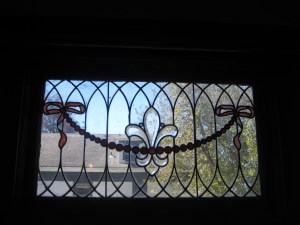
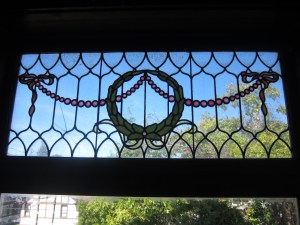
Although the second Flavel house is not rumored to be haunted, it has a dark history. At age 20, in 1947, the younger Harry allegedly attacked a neighbor with a hatchet. After that incident, Harry and his mother and sister were rarely seen in Astoria, becoming recluses in their own home. Years later, in 1983, Harry S. served time for stabbing a man. When he was released from prison after seven years, he and his family disappeared from Astoria. For twenty years, the house remained abandoned and derelict until the city of Astoria claimed the property. With signs of neglect and boarded up windows, the house certainly looked haunted, even if it’s not.

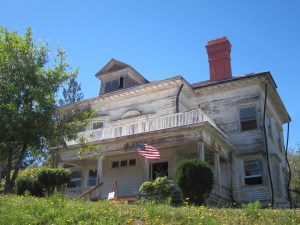
There is a happy ending to this story, however. In 2015, the house was sold to Greg Newenhof, co-owner of Astoria’s City Lumber Company. Since taking possession of the house, Mr. Newenhof has begun restoration, a long process to bring the house back to its former glory. In a partnership with the Clatsop County Historical Society, Mr. Newenhof recently opened his new home to the public, offering tours. Hundreds of people bought tickets. I was one of them—like the other visitors, I’d been interested in this house for years, and was so excited to finally be able to see the inside.
I wasn’t disappointed. The house has gorgeous historical details—paneled walls in the dining room, carved pillars in the sitting room, a beautiful fireplace in the living room, and marble sinks in each of the four bedrooms. My favorite room was the attic, because it still held some of the Flavel family’s belongings: an empty cradle, a tattered jacket, a drum, and old books.
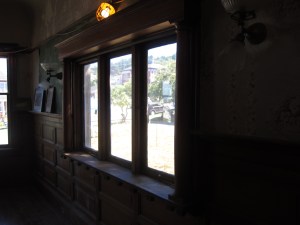

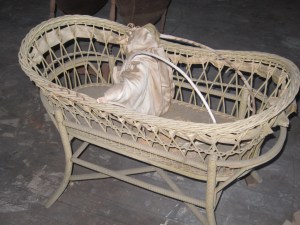
One of the reasons I wanted to see this house is it served as inspiration in my novel, Sunset Empire. I imagined one of my characters, Phantom, living in the house with his mother. To tour the house, and look out the windows at the Columbia River as I imagined my characters doing, was absolutely thrilling. It will be exciting to see the evolution of this house as Mr. Newenhof restores it. I hope he hosts a second open house when the renovations are complete.
© Melissa Eskue Ousley 2016
Stuff, Part II

Last night we placed a blanket on our lawn and watched the Perseid meteor shower. We had a good view on the Oregon coast—clear skies and no light pollution. Even though my boys are thirteen and already too cool for some of the things they used to enjoy, we all felt a sense of awe watching meteors leave brilliant trails of light on a black velvet sky.
 I love these moments. I know we’re too plugged in most of the time, each of us in our respective corners of the house. We’ve been better about unplugging this summer. One of my sons goes to swim practice four afternoons a week, so my other son and I committed to taking the dog for walks on the beach during that time. It’s been a good investment, if only for the chance to have deeper conversations with each other. We’ve enjoyed small discoveries—interesting rocks and shells, sculptural pieces of driftwood, washed-up jellyfish and isopods, and sculpin swimming in the estuary. One afternoon we didn’t walk at all, but stood mesmerized as we watched a whale breach over and over. It’s been good for the dog too, getting regular exercise. She’s a better dog for it, and we’re better people.
Even though my other son hasn’t been a part of our walks on the beach, we’ve included him in unplugging experiences too. We tried new restaurants and went roller skating a couple of times. He loves to read, so we’ve made weekly trips to the library. It’s been a great summer.
A complaint I’ve often heard about my boys’ generation is they can’t function without electronics—they always have to have a device in their hands, and they never go outside to play. They’re not social. They have no imagination. This is not true.
While my kids don’t play outside as much as I did, and they do love their phones and computers, that doesn’t mean they don’t like the outdoors. They do. Sometimes they just need a reminder to unplug, as do I.
They do have imaginations, and use them to create all kinds of art. Sometimes that art is made using pencils and paint, other times it involves a virtual canvas. They problem-solve constantly, whether it’s building worlds in Minecraft or solving puzzles in online games. They learn all the time. If they can’t figure something out, they research it using online resources. They watch videos about science experiments as well as silly stunts. They learn social skills, working with friends to win games. Yes, they are chatting over a distance, but they are still communicating. They talk to their friends in person too.
I think the biggest difference between their generation and others has to do with stuff. It’s not that my children don’t enjoy material belongings, but what they value is often virtual. They are not into physical toys. They still receive them as gifts sometimes, and they do play with them, but the enthusiasm is not the same as for online games.
When they were little, they enjoyed toys more. They had stuffed animals, legos, cars, dinosaurs, even toys they could ride. We had a lot of fun playing together, but every year we’d sort through the toys, passing along older toys to make room for new ones. Somehow we ended up with entire collections of Happy Meal toys—the other day I found one under the seat of my car. We got rid of boxes of toys and clothes before we moved 1,500 miles from Arizona to Oregon, but still, we had boxes and boxes that made the journey. In third grade, the boys’ teacher mentioned a project to give toys to other children. To my surprise, my kids were eager to participate. We went through their closet and collected five boxes of toys to give away. I was proud of my boys’ generosity, and amazed by their ability to let go of material belongings. It inspired me to go through my closet too. Letting go of my own belongings was a relief—it made me feel less weighed down. I wish I’d done more purging before we moved all those heavy boxes across the country.
Virtual toys are certainly lighter than physical ones, and they take up less room. I love that my boys don’t go crazy when we visit stores, wanting to buy more stuff. They see things they like, but they weigh the costs of purchasing them. They have learned to save their chore money for things they really want. This year one of my sons has made three major purchases with the money he’s earned: a video game, a fish tank, and a ukulele. The other, who hardly ever spends money, has only bought two items: a video game and an ocarina, which is a small, ceramic wind instrument.
The only problem with the boys not being into physical toys is gift-giving. While my husband and I know what games they’re into at the moment, it’s hard to translate this for relatives who are shopping for birthday or Christmas presents. To me, it feels selfish to ask for a gift card or cash even though the boys’ interests are so specific I know it will be nearly impossible for someone to find the exact gift they’ve been wanting. Asking for that feels like a demand, even though I prefer gift cards because they don’t take up space and they save on shipping costs for the giver. I also feel we shouldn’t make demands about the amount spent—it’s about being thought of by the giver.
I actually wish people wouldn’t give me gifts at all—just send me a note with kind words or give the money that would have been spent on a gift to a charity. I have everything I need, and the few things I want, I tend to buy for myself. I have more than enough. I know it’s not fair of me to force that idea on other people, however—on my kids or the people who give them gifts.
I don’t have an answer about how to handle the gift issue except to make gentle suggestions to givers and to teach my boys to be grateful receivers. And to periodically go through our stuff and pass along what we no longer need.
© Melissa Eskue Ousley 2016
 MELISSA ESKUE OUSLEY